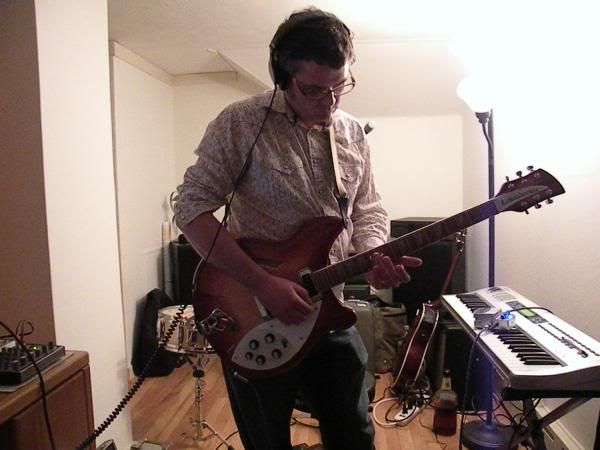
 Recording a cover of "Always On My Mind" at Mike's (My mUsic aTlas) house for Brigid. Hear it here.
Thursday, January 7, 2010

Friday, October 23, 2009

Monday, March 2, 2009
Rules of Distraction
Rules can be useful tools. For example, the Rules of Dating can be very useful in meeting the wrong person. On a first date, if the other person follows the same dating rules that you employ, then you can learn a lot about them. First, that they follow dating rules. Second, they read similar magazine lists and articles as you do. And last, they are just as afraid to reveal anything meaningful about themselves as you are. Dating Rules are as useful as Dating Attire. The Dating Attire shows you how the person usually wouldn't dress. Dating Rules show you who they are not.
There are as many articles, books, and lists of Dating Rules as there are lonely people, multiplied by a factor of eight, divided by one, and added to zero, or (x)8/1+0= alot. This is known as Cupid's Constant. I made that up, but it sounds scientific, and the point remains the same. Ellen Fein and Sherrie Schneider wrote one such book, The Rules: Time Tested Secrets for Capturing the Heart of Mr. Right. This is a great title, for reason and experience show that love is something to be captured. A fun, romantic way to capture a lover is the time honored tradition of deception. If there's just one positive use of Dating Rules, it's this: Total deception.
Fein and Schneider's handy Rule 2, "Don't Talk to a Man First, "offers women a particularly useful tool of romantic deceit—play dumb. The authors put it more eloquently though, "Men aren't interested in women who are witty…If someone asks you if you're having a good time, simply say yes and smile." This may not work with some men, but is an incredibly powerful tool in attracting that most desirable type of man, the arrogant, self-obsessed wind-bag. In fact, a woman may never have to be herself again. It stays cooler in the shade.
There are Dating Rules for men as well, such is the progressive state of modern dating. Samantha Daniel has come up with 20 of these rules. Her 20 Simple Tips for the Perfect Date will keep a man so preoccupied he'll have no time to listen or pay attention to his date, which is no problem, assuming his date has read Fein and Schneider's Rule 2 and isn't saying anything, anyway. Daniels' rules will effectively stifle any chance of unseemly spontaneity in a relationship. She has everything decided for the dater, from what day of the week a date should be on, to what exactly should happen before, during and after a date.
Combined, these two sets of rules should do an effective job of making sure neither party ever knows anything about the person they are dating. If, by some disastrous circumstance the dating duo do get to know each other, they can promptly break up, confident that they have the necessary tools to enter the dating scene all over again.
It is quite possible that without these rules, society as we know it would collapse. There are those radicals among us that might offer different advice for dating. These people might say, "Respect yourself and the other person," or, "Be yourself, and the rest will come naturally." Theses lunatics might even suggest that true love isn't just about getting the best score in the Dating Game. Instead, it is about getting to know and be with someone whom you appreciate and put their happiness at an equal level to your own, unconditionally. There is a word for these people. Anarchists.
Tuesday, October 14, 2008
A Harvest of Gravity

Music is the gravity that keeps us in steady revolution at The Orchard. Without this musical gravity, each of us, each individual satellite, may be flung off into the far reaches of a vast, cold, and uncaring universe. Yet, this gravity is there, and we revolve in orbit, sometimes as planets in steady revolution, others as comets, occasionally dive-bombing towards the epicenter, only to escape as quickly as we arrived.
Located just a few miles east of the small college town of Corvallis, Oregon, on Highway 34, The Orchard is, specifically, a few acres of land lined with rows of filbert trees and perhaps a dozen apple trees. There is a creek that runs through the the property guarded by a fortress of blackberry bramble. There is a 4 bedroom house and a 2car garage. A large deck overlooks small garden plots occasionally nibbled by rabbits, and an inflatable pool with a thin film of flotsam and jetsam. Regulation horseshoe pits are shaded by great sequoia trees and aged apple trees. There is a decrepit chicken coop, and not far from it, a small, weathered motorboat at the edge of the property that no one knows anything about. It has always been there.
The Orchard is more than this, of course. It is a community of music. The house is tenant occupied, anchored by a young married couple and supplemented by a rotating cast of room-mates. In addition to these paying tenants, the supporting cast—asteroids, comets and plutons–consist of various local musicians, young and old, veteran and new. Stars form in nebulae, and dense black holes absorb all they encounter. The basement functions as a rehearsal space 7 days a week and a performance space once every couple of months or so. Upstairs, the original living room is the control room for recording. Snakes, bundles of instrument and microphone cables, slither from tape machines, computers and processors down to the instruments below. Currently, 6 or 7 bands practice at The Orchard, and over the years, many more have practiced, preformed and recorded there.
Though music is the point, practice often consists of much more. An hour of music can be sandwiched between: barbecues, games of horseshoes and basketball, trips to the creek, strolls through rows of filbert trees at twilight, watching deer startle in the field, harvesting blackberries or herbs, shooting rifles, or splashing about in the pool. Often, these activities are fueled or hampered, by alcohol or other intoxicants (though strict rules are enforced when shooting rifles). A typical Sunday afternoon may find 3 or 4 bands participating in these activities as they wait their turn to practice or record.
Gravity is a weak force. In Almost Everyone's Guide to Science, John Gribbon illustrates this well, "It takes the gravity of the entire Earth, pulling on an apple, to break the apple free from the tree and send it falling to the ground, But, a child of two can pick the apple up from the ground, overcoming the pull of gravity." However, gravity also can keep the solar system together, planets, asteroids, comets, sun and Kuiper belt functioning as one whole entity. Life on Earth depends on the sun. The Sun remains indifferent to our existence. The weak force of gravity, though, is all that is needed to form a necessary relationship between the fiery furnace and the blue planet.
Music is much the same as gravity. Relationships at The Orchard range from(and fluctuate between) polite tolerance and appreciation, friendship, and romantic love. For every pleasant memory, The Orchard also presents challenging traumas and tribulations. Allegiances change. Love develops or collapses. Bands come and go, only to return again. Music may not soothe every wound encounter, but it keeps us going. Whether acquainted, befriended or enamored, this is what we love, and this is what we cherish. In an essay, Kathleen Norris asks, "How do we tell the truth in a small town? Is it possible to write?" I'm not sure about writing it, but at The Orchard, we play it on guitar, banjo, drums, and booze.
Subscribe to:
Posts (Atom)